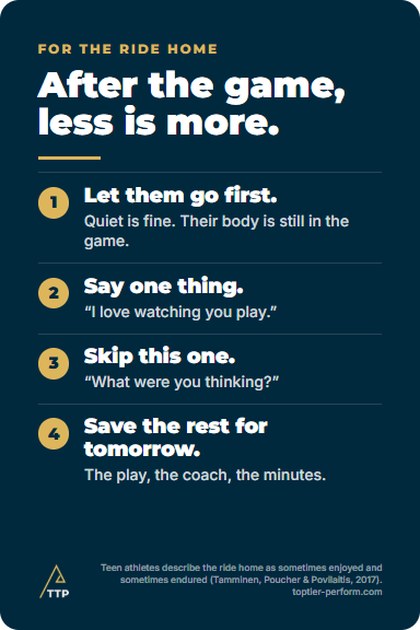
You're in the driver's seat. Your athlete is next to you, still in their gear, staring out the window. It was a rough one, and you know it. You've got twenty minutes before you're home, and every sentence you could say seems to have a wrong version attached to it. Say too much and it lands as criticism. Say nothing and it feels like you don't care. So you sit there, hands on the wheel, trying to figure out which words are safe.
If that's you, take a breath. You are not doing this wrong. The fact that you're thinking this hard about it means you care, and that already puts you ahead of where most of us start.
This article covers:
- Why this moment feels so hard, and why that's not a sign you're failing
- What's actually happening in your athlete's body right now
- Why feedback and encouragement matter more than analysis
- The exact lines that work, the ones to retire, and one habit to build
You Are Not Getting This Wrong
Most of what parents say in the car comes from love. You saw your kid hurt, disappointed, or embarrassed, and every instinct you have wants to fix it or make it better right now. That instinct is not the problem. Almost every parent who has ever driven a silent kid home has felt exactly what you're feeling.
You don't need to have the perfect line ready. You need to understand what's happening for your athlete in that seat, and a small shift in when and how you talk about the performance. That's it.
What Your Athlete's Body Is Still Doing
Right after a tough performance, your athlete's body is often still running on the reaction: the automatic, no-control surge that shows up when something goes wrong. Heart rate still up, chest still tight, thoughts still looping on the mistake. That reaction isn't something they're choosing. It's the same as flinching at a loud noise. It fades with time, not with more input.
Coaching, even gentle coaching, dropped into that window tends to land as criticism, no matter how kindly it's meant, because the part of the brain that can calmly process feedback isn't fully back online yet. The words might be right. The timing is what's off.
If your athlete is quiet, quiet is not a problem to solve. It's often the reaction working itself out. Give it room before you give it words.
Why Feedback and Encouragement Matter
Research on where athletes get their confidence from, led by Vealey and colleagues, names feedback and encouragement from parents, coaches, and teammates as one of the real sources: praise, technical instruction, and what's called error-contingent encouragement, meaning encouragement given specifically around a mistake. That kind of support builds confidence. Detailed analysis of what went wrong, especially right after the fact, usually doesn't, even when it's accurate.
There's a second piece worth knowing. Achievement Goal Theory draws a line between task focus, getting better at the skill itself, and ego focus, measuring yourself against beating other people. Task focus holds up better after a bad day, because it gives your athlete something to work toward instead of something to feel bad about. The questions you ask in the car can nudge them toward one or the other without you realizing it.
What Actually Works
Here are lines that tend to land well, right after a rough performance:
- "I love watching you play."
- "Do you want to talk about it, or leave it for tonight?"
- "What's one thing you did well?"
Here are the lines worth retiring, even though they usually come from a good place:
- "What happened out there?"
- "You should have taken that shot earlier."
- "Why weren't you more aggressive?"
One Habit to Build
If there's real feedback to give, technical or strategic, save it. Pick a fixed time later in the week, and let your athlete choose it: after dinner, before practice, whenever works for them. Giving them the choice matters. It turns the review into something they're part of, not something that happens to them.
One more thing you can do on your own time: take the free parent check. You answer from where you sit in the stands, and it shows where your athlete's mental game stands right now and one next step that fits. It's a self-check, not a clinical assessment. If you want something to keep in the car, the free cards for parents print at home.